Can surveillance rely on facial recognition in the world of coronavirus?
It’s a scenario out of your favorite sci-fi dystopia – at a checkpoint or on arrest, police summarily scan the face, fingerprints, iris, or spit to provide instant identification.[1] Late last year and Earlier this year in Hong Kong protestors and news media widely speculated facial recognition technology was being used to target pro-democracy protests.[2] Protesters were documented using umbrellas to hide from CCTV cameras, using spray paint or lasers to disable cameras, or outright destroying them. In what has become a symbol for anti-government protest in our times, protestors donned Guy Fawkes masks and other facial coverings to avoid facial recognition identification.
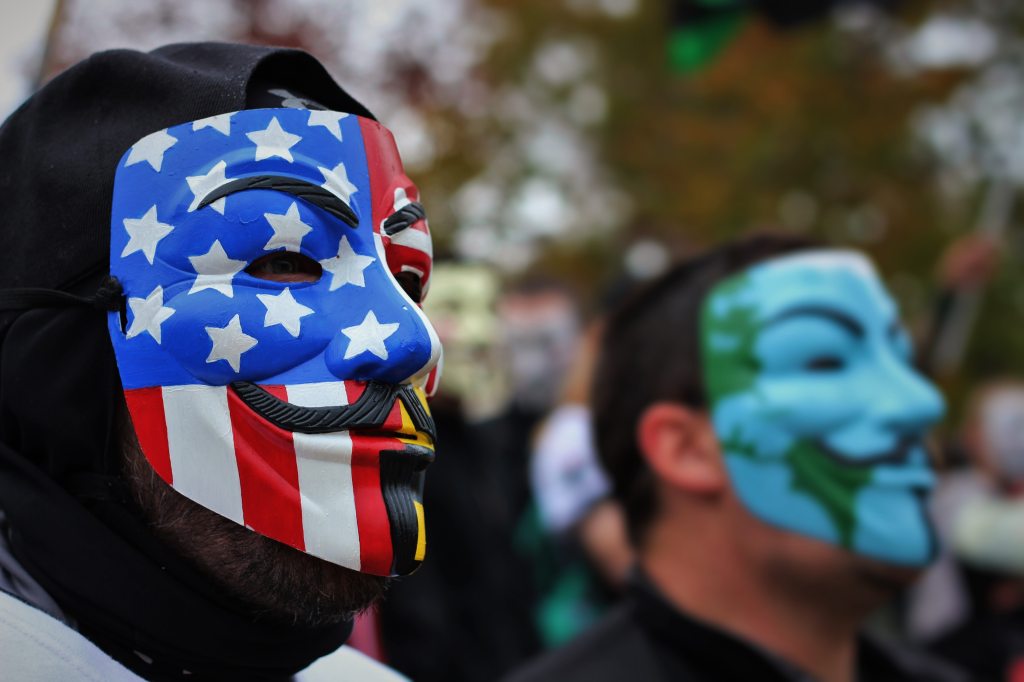
Late last year I wrote a paper for an artificial intelligence seminar that discussed facial recognition surveillance in the context of the Fourth Amendment. An issue I barely addressed in the paper was the use of face coverings to circumvent facial recognition technology, mostly in the context of the Hong Kong protests. The U.S. has a long and ugly history with face coverings – many states rightfully have anti-mask statutes enacted during Reconstruction to fight the resurgence of the hood-wearing KKK.[3] I assumed our cultural distaste for face coverings would make this an unlikely form of resistance to facial recognition.
Well, there’s nothing like a pandemic to challenge your assumptions. Face coverings are now mandatory in many states (including mine, Pennsylvania) if you want to enter a store. Based on an informal survey of walks in my urban Philadelphia neighborhood, I’d say 60-70% of people now regularly wear masks outside. Some people have pointed out the, erm, irony of our new normal:
The tl;dr to my paper (which I’ll do a more comprehensive review of in the future) was that the Fourth Amendment isn’t going to provide any meaningful protection to citizen’s privacy against facial recognition. Though Carpenter has begun paving a road towards the idea of a public privacy right, the limited decision focused on technologies that are “detailed, encyclopedic, and effortlessly compiled.”[4] I argued law enforcement use of facial recognition likely won’t be challengeable under the Fourth Amendment until it reaches a similar ubiquity to CSLI (and at that point, the cat will be out of the bag, pandora’s box opened, etc.). There is also a persuasive argument that as long is the technology is not paired with extensive surveillance networks (which is happening in China and the UK) and used as an in-the-moment identifier, it is no more invasive than fingerprinting as a form of identification.
Of course, these are analysis of government uses of privacy invasive technologies. One of the more bizarre features of American life is our deep-rooted suspicion of our government, which is tastefully paired with our willing acceptance of corporate intrusions to our privacy. Because of this, facial recognition is more common as a tool on our own personal tracking devices, like Apple’s Face ID.
Apple announced an update to Face ID in response to our new mask-wearing reality, which boiled down to “we’ll stop trying so you can just enter your PIN.”[5] The technology relies on a full view of the eyes, mouth, and nose, and it doesn’t sound like Apple is working towards an “above the mask” quick fix anytime soon.
What does this mean for facial recognition surveillance? At this point, it seems like a mixed bag. While broad surveillance networks relying on CCTV may become less useful, investment in touchless identification technology is rising.[6] Second, facial recognition exists in what I’d call the surveillance penumbra. AI algorithms are attacking human identification problems from multiple angles, and facial recognition is just one of them. Two examples are gait recognition and DNA phenotyping – gait recognition promises to identify a person by the unique way they walk, and DNA phenotyping suggests a person’s DNA can be used to create an accurate portrait.[7] Even if facial recognition is stopped cold by mask-wearing, its only one part of the many identification technologies being developed.
[1] Unless the protagonist has someone else’s eyes! I think? It’s been a while since I’ve seen Gattaca
[2] https://www.japantimes.co.jp/news/2019/10/23/asia-pacific/hong-kong-protests-ai-facial-recognition-tech/
[3] Jay Stanley, Opinion: The Right To Hide Your Face, Buzzfeed News Opinion (Nov. 26, 2019), https://www.buzzfeednews.com/article/jaystanley/facial-recognition-right-to-wear-a-mask.
[4] Carpenter v. United States, 138 S. Ct. 2206, 2216, 201 L. Ed. 2d 507 (2018).
[5] https://www.cnet.com/how-to/apple-wants-to-make-face-id-work-better-with-your-face-mask-heres-what-we-know-update/
[6] https://www.biometricupdate.com/202005/biometrics-industry-could-lose-2b-this-year-from-pandemic-but-facial-recognition-market-to-grow
[7] https://www.biometricupdate.com/201810/facial-recognition-and- dna-sequencing-technology-used-to-generate-facial-images-from-genetic-material; https://apnews.com/bf75dd1c26c947b7826d270a16e2658a?.
 Dumb Privacy Guy