If you’re a state-endorsed peacekeeping organization, how do you respond when people refuse to keep the peace? One option, apparently favored by law enforcement here in Philadelphia, is to let people go hog wild, then later identify and prosecute them from all the videos other people took of them breaking the law.
I doubt anyone reading this blog is unaware of the social situation in the US, but to recap: on May 25, Minneapolis Police Officer Derek Chauvin knelt on the neck of George Floyd, slowly suffocating him in front of a crowd of onlookers and other officers. People were rightly outraged, and protests took off in Minneapolis and around the country, with thousands of Americans calling for justice and a reformation of local militarized policing. In some of these protests clashes between police and protestors ignited into rioting, which happened in Center City Philadelphia on May 30th. As part of the riots, several Philadelphia Police vehicles were destroyed – and US Attorney William McSwain was anxious to find the people responsible for the damage.
On June 17th, McSwain announced charges against a protestor for arson of two Philadelphia Police Department cars.[1] More notable than the charges was HOW the FBI managed to find the accused, Lore-Elisabeth Blumenthal. According to the affidavit[2] filed by FBI Special Agent Joseph Carpenter, the following breadcrumbs were followed to identify the accused:
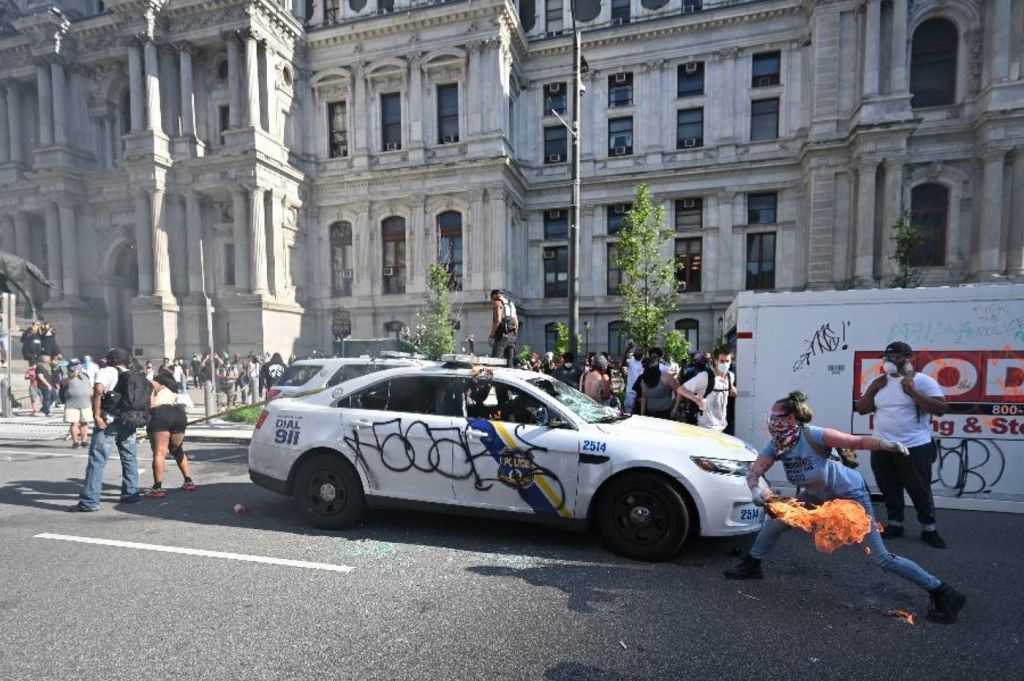
First, in this image, we can see a woman about to set fire to a PPD car. Along with hundreds of images obtained from amateur photographers at the protests, the FBI was able to identify two distinctive features of the woman: her t-shirt, which reads “KEEP THE IMMIGRANTS, DEPORT THE RACISTS” and a stylized peace sign tattooed on her right arm.
FBI investigators then found that the t-shirt was custom made on an Etsy site. Now, from here it gets weird:
The top review on her page, dated just six days before the protest, was from a user identifying herself as “Xx Mv,” who listed her location as Philadelphia and her username as “alleycatlore.”
A Google search of that handle led agents to an account on Poshmark, the mobile fashion marketplace, with a user handle “lore-elisabeth.” And subsequent searches for that name turned up Blumenthal’s LinkedIn profile, where she identifies herself as a graduate of William Penn Charter School and several yoga and massage therapy training centers.
From there, they located Blumenthal’s Jenkintown massage studio and its website, which featured videos demonstrating her at work. On her forearm, agents discovered, was the same distinctive tattoo that investigators first identified on the arsonist in the original TV video.[3]
After obtaining a warrant, police say they found “the same goggles, backpack, and flame-retardant gloves worn by the masked woman in the video who set the squad cars ablaze” in her apartment.[4]
This event has been widely covered, mostly under headlines that hit the big points: FBI, social media, tattoo, Etsy.[5][6] The tone of this coverage usually falls somewhere between “creepy how the FBI can do this” and “Wow! The resourcefulness of our boys in blue.” This story, and this moment, should inspire some interesting thoughts on how protesting impacts privacy.
First, surveillance comes in all forms. In my last post[7] I discussed how facial recognition might change in the era of the pandemic – or more accurately, how it might try and ride this one out and wait for people to stop wearing masks. While this FBI research method is interesting, it’s no more complicated than something Ashley Feinburg has done many times in the past.[8] Government surveillance can come from the police installing surveillance cameras or using drones to film protests, but it can also come from people just, ya know, taking pictures and putting them online. We leave breadcrumbs of ourselves all over the internet, much like Lore-Elisabeth, because it’s easy and you don’t think about it. You leave a nice Esty review that happens to reveal what city you live in. You record a video for your massage-parlor small business that clearly shows your forearm tattoo. You have a LinkedIn page. Alone, these are inconsequential acts, but once the government (or Ashley Feinburg) decides they want to find you, all the little pieces come together to sufficiently lead to the FBI knocking on your front door.
Second, we should be honest about the double-edged sword of recording. I would argue this moment in protest history exists because 1) we are all videographers, and 2) social media allows us to spread what we record. The people are usurping the media and inspiring a political movement by recording the vicious acts of law enforcement against those they swear to protect and serve. Here in Philadelphia, infamously violent police officer Joseph Bologna Jr. was fired and arrested after he was captured on video beating a Temple student.[9] It is doubtful that at any prior moment in history an officer in Bologna’s position would be recorded or face consequences for those acts, but smartphone video + social media has brought accountability to a previously unaccountable person. There are countless other incidents right now of people paying the piper for their acts: angry DC bikers[10] and racist teens[11] alike. Beyond protests against police brutality, this is becoming an accountability moment for white Americans in our society. People are rightfully held accountable for their unconscionable conduct, whether it is saying slurs or assaulting protestors, all fueled by the sticky memory of the Internet. However, that sticky memory can work against you when you’re blatantly breaking the law, like when you set a cop car on fire. You might not be cancelled on social media, but you’ll be cancelled in a court of law.[12] I’ve seen many pro-protestor people on twitter demand those recording events anonymize the protestors to protect against criminal charges and retribution, while also decrying police who cover up their badge numbers. Both sides appear increasingly aware of omnipotent surveillance, and desperate for anonymity to hide from its consequences.
Finally, is normcore having a protest moment? You’ll remember normcore as a 2014 fashion trend where we all admitted that we’re not interesting.[13] Well, as the Blumenthal case shows, distinctive clothing and tattoos can be a liability when protesting the state. Maybe in the protest era normcore will make a comeback. Pro-protest organizations are attempting to educate protestors about the surveillance tactics used in this case (and presumably others). I propose the protestors show up in groutfits – harder to individualize and identify, and certainly more comfortable.
[1] https://www.justice.gov/usao-edpa/pr/us-attorney-mcswain-announces-charges-against-philadelphia-woman-arson-two-philadelphia
[2] News organizations: LINK TO THE DAMN COURT DOCUMENTS. Why do you not link to original sources.
[3] https://www.inquirer.com/news/philly-protests-arrests-fbi-lore-elisabeth-blumenthal-george-floyd-20200617.html
[4] https://www.inquirer.com/news/philly-protests-fbi-lore-elisabeth-blumenthal-arrests-prosecution-george-floyd-20200619.html
[5] A Tattoo and an Etsy Shirt Led Cops to Arrest Woman Accused of Burning Cop Cars https://www.vice.com/en_ca/article/bv8j8w/a-tattoo-and-an-etsy-shirt-led-cops-to-arrest-woman-accused-of-burning-cop-cars
[6] FBI Uses Social Media, Etsy And A Tattoo To Track Down Woman Accused Of Torching Cop Cars https://www.zerohedge.com/technology/fbi-uses-social-media-etsy-and-tattoo-track-down-arsonist-who-torched-cop-cars
[7] Over a month ago! I apologize.
[8] Queen of the internet.
[9] https://www.nbcphiladelphia.com/news/local/philadelphia-police-inspector-charged-for-alleged-attack-on-protester/2421855/
[10] https://www.npr.org/2020/06/06/871479455/maryland-man-charged-in-assault-on-activists-for-racial-justice-along-d-c-area-t
[11] https://www.forbes.com/sites/abrambrown/2020/06/12/how-teens-are-using-anonymous-google-docs-and-enlisting-a-youtube-star-to-out-allegedly-racist-classmates/#181ceb501a78
[12] Sorry.
[13] https://www.thecut.com/2014/02/normcore-fashion-trend.html
 Dumb Privacy Guy